
Why you should read this blog post ?
Target Audience
Questions We Answer
Related Service
What Flooring Waste Can Contractors Prepare for Pickup?
The first job is to establish exactly what the installation has left behind. An office refit might produce stacks of old carpet tiles, small pieces trimmed around columns, foam underlay and cartons from the replacement tiles. A residential project may also leave loose vinyl sheets or laminate planks. These aren’t necessarily treated as one material, even if they’re in the same room.
Identify Detached Carpet Tiles and Offcuts
Walk through the completed work area and list each waste type separately. For carpet tiles, note whether the pile contains complete squares, damaged tiles or small cutting scraps. Backings vary: some tiles are noticeably denser or stiffer than others, which can affect handling and the likely weight of the load.
Record the following details before requesting carpet tile waste collection:
- Removed carpet tiles: Approximate count, tile size and whether they are neatly stacked.
- Installation offcuts: Number of bags or bundles, including strips from doorways and perimeter cuts.
- Other loose flooring: Detached carpet rolls, vinyl sheets or laminate planks, described by type.
- Condition: Whether the material is dry, damp, heavily soiled or carrying visible residue.
Only include materials that are actually ready for collection. Our carpet removal service covers accepted flooring waste that has already been detached, including carpet tiles and underlay. Lifting fitted carpet, stripping floors and scraping adhesive must be arranged separately.
Separate Underlay, Packaging and Other Flooring
Keep carpet tiles, underlay and packaging in identifiable groups. Stack tiles flat at a manageable height and secure loose offcuts in bags or bundles. Roll foam or felt underlay where practical; dense rubber underlay may be heavier than its size suggests. Flatten clean cartons and gather plastic wrapping away from the flooring pile.
Before throwing out unused tiles, ask the client or facilities manager whether spare pieces are needed for future repairs. Label anything to be retained and place it outside the collection area. A labelled spare-tile stack is less likely to be mistaken for rubbish during a busy office handover.
How to Estimate Carpet Tile and Flooring Offcut Waste
Flooring installers often work from square metres, but the area of flooring removed is not the same as the space the waste occupies in a truck. Stacking, backing thickness and bulky underlay all affect volume. A practical estimate combines tile counts with measurements of the actual piles.
Count Carpet Tiles and Measure Waste Stacks
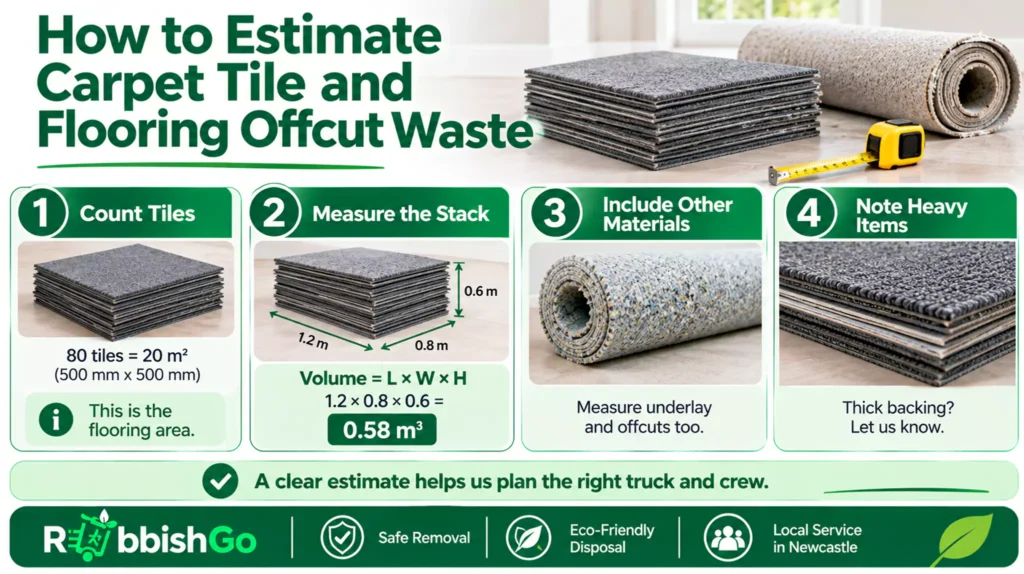
Start with the complete tiles. If 80 removed tiles measure 500 mm by 500 mm, their combined face area is 20 m². That describes the flooring area, not the waste volume. To estimate the space occupied by a stack, measure its length, width and height in metres.
Stack volume (m³) = length × width × height
For example, a stack measuring 1.2 m × 0.8 m × 0.6 m occupies approximately 0.58 m³. Measure a separate underlay pile in the same way if its shape allows. For irregular piles, give an approximate dimension and attach a wide photograph rather than claiming false precision.
Document small offcuts as bags or bundles, with a photo showing their size. If installers are still working in another room, mark the measurement as provisional and update it when the final clean-up is complete. Our guide to estimating rubbish volume in cubic metres explains the measurement method in more detail.
Record Heavy Backing Materials and Bulky Offcuts
Two stacks with the same dimensions can weigh very differently. Thick rubber-backed carpet tiles, damp underlay or tightly packed flooring strips may need more handling than a similarly sized pile of dry foam. Tell the collection provider if anything seems unusually heavy.
Where available, retain the tile product name or backing specification. This may help identify the material without making assumptions from its appearance. Don’t estimate weight from tile count alone unless you have reliable product information.
Check Adhesives, Moisture and Unknown Flooring Materials
Certain materials require a decision before they’re added to a normal flooring waste pickup. Make this check while the installer or site supervisor is still available to explain what was removed. If something cannot be identified, leave it out of the general pile until its handling requirements are confirmed.
Identify Adhesive Residues and Chemical Waste
A detached tile with a trace of fully cured adhesive is different from an open container of flooring glue. Photograph residues on the backing and note whether they are dry, tacky or wet. Keep leftover adhesive, primer, solvent and other chemical containers separate; they must not be slipped into a bag of carpet offcuts.
RubbishGo does not include adhesive scraping in its carpet collection service, and liquid chemicals or regulated hazardous waste are outside standard pickup. Even where residue looks dry, acceptance needs confirmation rather than guesswork. If the subfloor still needs cleaning or scraping, arrange that as part of the flooring works, not the waste collection booking.
Handle Wet Flooring and Suspected Asbestos
Wet carpet tiles and underlay can be substantially heavier than dry material. State whether the waste was affected by a known clean-water leak, flooding or an unknown source of moisture. Photograph the material and keep it apart from clean offcuts until the provider confirms whether it can be handled.
Older flooring systems may include asbestos-containing vinyl, backing, underlay or adhesive. Appearance alone cannot reliably rule asbestos out. If a material is suspect, stop disturbing it, restrict access and ask a suitably qualified asbestos professional to assess the situation. Do not cut, bag or move suspect material with ordinary carpet waste.
Asbestos is not accepted in RubbishGo’s standard collection.
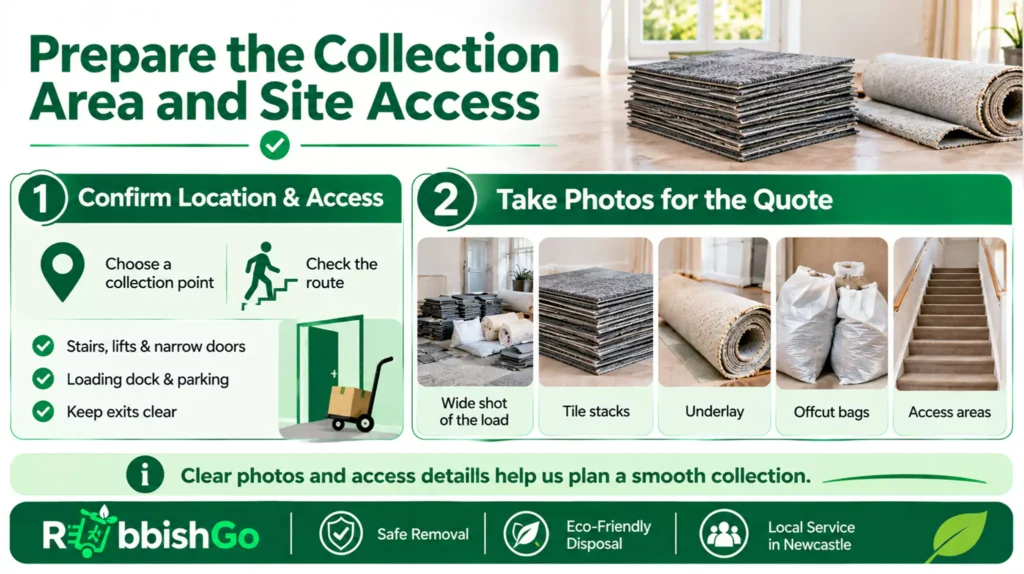
Prepare the Collection Area and Site Access
Once the waste has been sorted, decide where the crew will collect it. The most convenient place for an installer is not always accessible to a loading vehicle. Occupied offices, shopping centres and strata buildings may have restrictions that need to be resolved before pickup day.
Confirm the Pickup Location and Loading Route
Choose a defined, safe collection point and tell the provider whether it is indoors, in a garage or beside an approved loading area. The waste doesn’t automatically need to be taken outside: collection from an accessible indoor area can be arranged when it is included in the quote.
Walk the route from the pile to the vehicle and record any obstacles:
- Floor level, stairs and lift availability or dimensions.
- Narrow doors, long corridors or unusually long carries.
- Loading dock bookings, building security and site induction requirements.
- Parking limits, vehicle height restrictions and permitted collection hours.
Keep emergency exits, shared corridors and public footpaths clear. Ask the building manager who can authorise access and whether lift protection or a loading booking is required. For multi-storey sites, our guide to apartment rubbish removal access for Lake Macquarie covers related access issues.
Take Photos for the Collection Quote
Photographs should show both the rubbish and the conditions under which it will be collected. A close-up of one tile cannot convey the amount of waste left across several rooms.
Take a wide shot of the entire load, followed by separate images of tile stacks, underlay, offcut bags and packaging. Add close-ups of unusual backing or adhesive residue. If access is restricted, photograph the corridor, stairs or loading area as well.
Take the final set after cleaning up the last room. If more waste is added later, send updated images before collection. Name one person who can confirm the load and provide access on the day; this might be the flooring foreperson, site supervisor or facilities manager.
Can Other Renovation Waste Be Included in the Pickup?
Flooring work is often one part of a larger fit-out. Once the tiles are removed, there may also be skirting offcuts, timber, plasterboard, cardboard or other building rubbish waiting to leave the site. Don’t assume all of it belongs in the carpet collection just because it is nearby.
Separate Additional Renovation Debris
List additional materials outside the carpet tile inventory, with photographs of each group. In particular, distinguish light packaging from heavy debris such as broken ceramic tiles or masonry. These materials can have different loading and disposal requirements.
If the job includes other accepted loose building rubbish, you can include other renovation debris in the enquiry for assessment. The provider must confirm what belongs in the quoted load before it is combined for collection.
Keep materials awaiting inspection or reuse well away from the waste. Spare skirting, unopened adhesive products and usable carpet tiles should not become accidental additions. A short sign marked Keep – Not for Disposal can avoid an awkward mistake at handover.
Compare Scheduled Pickup With Skip Bin Hire
A scheduled pickup generally suits a finished flooring job with a known quantity of detached waste and a clear collection point. The collection crew loads the agreed materials, so installers can hand the site back once their own work is complete.
A skip bin may suit a longer project that produces waste over several days, provided there is space for it and the supplier accepts the relevant flooring materials. The contractor normally handles loading and must observe the bin’s material and weight limits.
If the choice is unclear, compare the amount of ongoing waste, site space, access and labour. Our skip bin hire versus rubbish removal guide outlines the practical differences. Neither option should be booked until the waste types and any restrictions are known.
Contractor Flooring Waste Pickup Checklist
The final handover should be short enough for a busy site contact to use and detailed enough for the collector to quote the right work. Fill it out when the last offcuts have been gathered, not while another room is still being stripped. A completed checklist also gives the client a record of what was nominated for disposal.
Material and Quantity Handover Checklist
| Check | Information to confirm | Done |
| Carpet tiles | Detached, counted or stacked; approximate dimensions and backing identified | ☐ |
| Underlay and offcuts | Type, quantity and separate bags or bundles recorded | ☐ |
| Other flooring and packaging | Loose materials listed and photographed separately | ☐ |
| Adhesives and contamination | Residues, moisture and unknown materials flagged for assessment | ☐ |
| Materials to retain | Spare tiles and usable products clearly labelled and excluded | ☐ |
| Load estimate | Pile measurements or bundle counts supplied with full-load photos | ☐ |
| Pickup point | Exact location and unobstructed route agreed | ☐ |
| Access | Parking, stairs, lifts, dock booking and site contact confirmed | ☐ |
| Booking | Accepted items, quoted work and collection window confirmed | ☐ |
A tick confirms the contractor has checked the item; it does not mean every material has been approved for collection. If a line remains uncertain, describe the issue in the booking message rather than hiding it inside the pile.
Example: Completed Office Flooring Installation
The following is an illustrative handover note, not a record of an actual RubbishGo collection.
Project: Office carpet tile replacement, Newcastle NSW
Status: Flooring installation finished; waste already detached
Waste: 64 carpet tiles (approximately 500 mm × 500 mm) in 4 stacks; 2 rolls of foam underlay; 1 bag of installation offcuts; 3 flattened cardboard boxes
Condition: Dry; tile backing shown in close-up photos; no chemical containers included
Location: Ground-floor storage room
Access: Loading dock booking subject to building management approval; clear internal route required
Site contact: Flooring foreperson, contact details supplied with booking
Photos: Whole load, each material group, backing and loading route
Collection window and acceptance: To be confirmed before pickup
The example shows which details remain unresolved: loading dock approval and the collection window.
Confirm the Final Pickup Details
Before booking, review the material list against the photographs one last time. Include the suburb, preferred day, any restricted access hours and whether the load must be collected from inside the property. Agree on who will meet the crew or provide entry instructions.
Before arranging collection, make sure the material list and photos reflect the final load. If you need to confirm what can be collected or discuss site access, you can contact our team with the relevant details. Any additional waste should be reported before pickup so the agreed collection arrangements can be reviewed.
Where the project requires waste records, keep the booking confirmation and any collection documents provided.
Carpet Tile Disposal for Contractors: Final Handover
A smooth flooring waste handover depends on a few decisions made before pickup: identify what’s detached, separate the materials, estimate the pile and show how the crew can reach it. More detailed attention is needed for adhesives, damp waste and anything that might contain asbestos.
For carpet tile disposal for contractors across Newcastle, the Central Coast and Lake Macquarie, the most useful starting point is a final material list supported by clear photos and accurate access details. That gives both parties an agreed scope before collection begins.